
I’ve been thinking a lot about where we started. Remember the initial hustle? It was all about chasing metrics, trying to outsmart the platform updates, and the stress of missing that prime-time posting window. It’s a good reminder of how much the landscape—and our approach to it—has evolved.
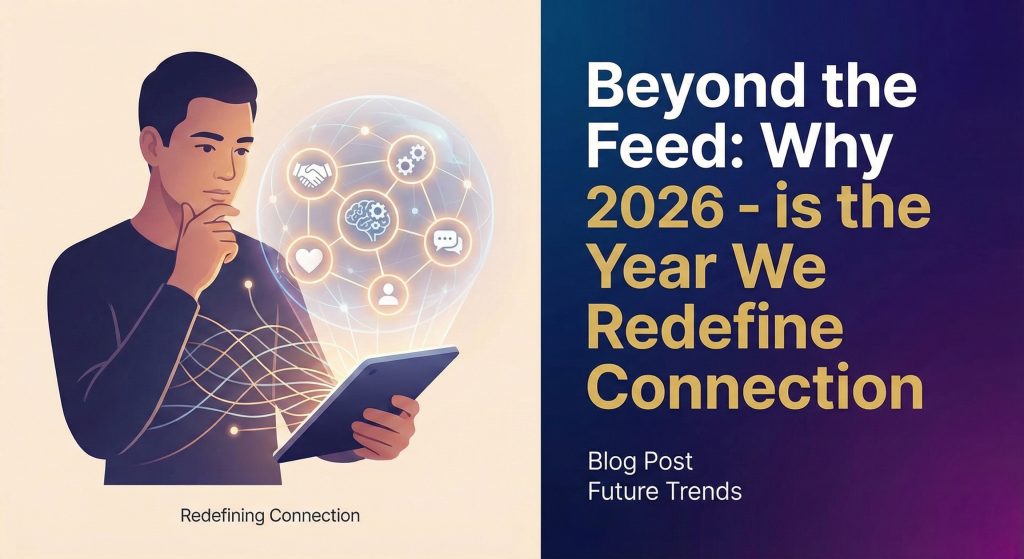
Looking ahead to 2026, that “churn and burn” approach feels archaic. It feels like a relic of a different internet. We are rapidly moving away from a fragmented collection of apps and stepping into a woven, intelligent ecosystem.
For us marketers, the next few years aren’t just about adaptability; they are about authenticity. Success is no longer about who shouts the loudest, but who connects the deepest.
Here are the shifts that are keeping me up at night—in the best way possible.
1. The Era of the “Helpful” AI Agent
We can all agree that the days of impersonal, clunky chatbots are numbered. Finally, we’re entering an exciting phase where AI evolves from being a barrier into a proactive partner, genuinely contributing to the conversation rather than just deflecting it.
This isn’t just about answering DMs faster. It’s about an AI that actually understands context. Imagine a bot in a marathon training group that offers advice on pacing or hydration before it ever tries to sell a pair of sneakers. We are shifting from talking at people to talking with them.
2. Commerce with Context (AR Grows Up)
Augmented Reality is finally graduating. It’s moving from novelty (dog ears and funny filters) to genuine utility. We aren’t just trying on lipstick virtually anymore; we are creating persistent digital layers over the physical world.
Whether it’s unlocking exclusive footage at a concert venue or visualizing how a sofa fits in a living room in real-time, commerce is becoming immersive. When done right, it doesn’t feel like “selling.” It feels like enhancing reality.
3. The Return of First-Party Trust
With privacy regulations tightening and cookies crumbling, we can no longer build our houses on rented land. We have to own the relationship.
As we look toward 2026, the smartest play is the ‘value exchange.’ We need to build spaces—whether they are private groups or high-value content hubs—that invite users to share who they are and what they want. But this is a two-way street. Users will only share their preferences if they trust us to bring something serious to the table. It’s about relationships over reach; we aren’t just capturing data anymore, we are earning it.
4. If They Can’t Search It, It Doesn’t Exist
Gen Z taught us a valuable lesson: Social platforms are the new search engines. This behavior is now universal.
Our content strategy needs to pivot from “viral” to “findable.” Optimizing for in-app search is the new SEO. It’s less about jumping on a trending audio and more about answering the specific questions your audience is asking—before they even type them.
5. Synergy Over Saturation
Here is a hard truth: You don’t need to be everywhere. You just need to be connected.
The trend is moving toward using massive platforms (like TikTok or Instagram) for discovery, but funneling your true fans into niche networks—hobby forums, audio spaces, and sub-communities. Think of it as moving people from the “crowd” to the “club.”
6. The “Authentic Synthetic” Balance
AI generation is inevitable. We use it, and we should. But the audience is craving humanity more than ever.
The sweet spot for 2026 is using AI to handle the heavy lifting (data, structure, variations) while providing nuance, emotion, and ethics. Transparency is key here. Labeling AI-assisted content shouldn’t be seen as a warning label; it should be worn as a badge of honesty.
Conclusion
The future isn’t just about being seen; it’s about being integrated into the user’s life. We need to stop viewing social media as a broadcast channel and start viewing it as a seamless service.
2026 isn’t about technology. It’s about how technology helps us feel a little more human.